
 EDITOR: Tyler Chadwick
FOREWORD: Susan Elizabeth Howe
AFTERWORD: Ángel Chaparro Sáinz
CONTRIBUTORS: See the complete list
Fire in the Pasture is an award-winning anthology that contains the poetry of eighty-two contemporary Mormon poets. It was compiled over a period of two years, beginning April 2009, and it was released October 15, 2011, by Peculiar Pages, an independent publisher of Mormon literature. All the poems in the collection were published between 2000 and 2011; several of the poems were published for the first time in Fire.
Purchasing information
Paperback: Amazon | Barnes & Noble | Powell’s | Books-a-Million
eBook: B10 Mediaworx | Amazon Kindle | Barnes & Noble Nook
Sampler (free downloads): 20 Poems from Fire in the Pasture: EPUB | Kindle | PDF | online
From the Association for Mormon Letters 2012 Poetry Award Citation
Fire in the Pasture records the changes, movements, and new and old themes that Mormon poets are and have been struggling with. The collection is highly representative of the various types of Mormon poets, with many up-and-coming poets included. That generosity alone merits the award. But the themes, styles and forms show great variety, and manifold interests. Although the poems in Fire in the Pasture do not uniquely deal with Mormon themes, anyone wanting to become more familiar with contemporary Mormon poets would benefit by reading this diverse collection of poems generated from Mormon cultural and religious expressions of both the sacred and the mundane.
Read the full Award Citation »
–Awarded at the AML Annual Conference,
Orem, UT, 21 April 2012
From the Preface
[A]s the editor of [Fire in the Pasture], my intention is to showcase poets who have emerged or established themselves since [the 1989 publication of Eugene England and Dennis Clark’s Harvest: Contemporary Mormon Poems], with special emphasis on poems written or published since the turn of the millennium. [In Fire] you’ll find a range of published and unpublished work from eighty-two poets, including new poems from eight of the younger Harvest poets: Susan Elizabeth Howe, Patricia Karamesines, John W. Schouten, Laura Hamblin, Lance Larsen, Philip White, Danielle Beazer Dubrasky, and Timothy Liu. This vanguard joins seventy-four established and up-and-coming poets to provide an expansive look at 21st-century Mormon poetry. The poems range from artfully crafted traditional forms—including sonnets, sestinas, and villanelles—to free verse to prose poems to light verse to dramatic monologues to translations to cowboy poetry. All of these represent the varieties of the contemporary lyric voice; and the range of poets speaking here represents the varieties of the contemporary Mormon experience—a chorus of voices that calls again and again for us to reconsider our relationship to poetry, to the modern world, and to 21st-century Mormonism.
–Tyler Chadwick,
Editor, Fire in the Pasture
From the Foreword
. . .the bounty of [this] anthology reminded me of Christ’s generosity in feeding the five thousand. Christ took real substances—a little bread, two small fish—and he created from them. . .food that nourished the people and made it possible for them to return to their lives both physically and spiritually renewed. Poets take matter (language, emotion, thought, experience) and make of that matter a new creation, a work of art that did not exist before the poet organized it, a work that has the potential (each poet hopes) to nourish—to make readers see what they did not see before, to offer insight, to create empathy, to provoke thought, or to express beauty, soundness, depth. To offer abundance in place of scarcity.
–Susan Elizabeth Howe,
Associate Professor of English, Brigham Young University
From the Afterword
The first thing that surprised me about [Fire in the Pasture] was its variety. There are different levels of attachment to the Church, motley themes, free verse and traditional forms, personal poems, elegiac poems, experimental poems, major topics, minor topics, new images, new mappings. American poetry is decentralized, richly varied, impossible to summarize. The same applies to Mormon poetry. . . .
And while all of these poets [in the anthology] deal with spirituality, faith or the gospel on different levels and with different objectives, it is always with complexity, a lack of fixation, and as an exercise in paradox. As Scott Cameron says, “Truth is not static; it collides.” This collision gives Fire in the Pasture a superb diversity. . . . As Jonathon Penny says, “This is a rather wretched place, / All things considered: / More paradox than paradise.” Paradox dissolves boundaries and contraries; it opens toward possibility and complexity without forcing us to choose between extremes.
–Ángel Chaparro Sáinz,
Assistant Professor of English, University of the Basque Country, Spain
Reviews
I’ll cut to the chase: The arrival of [Fire in the Pasture] is a landmark event. It has the potential to elevate Mormon culture. The volume attempts to present an enormous range of voices, each one interesting. . . .
If I have any credibility. . .regarding Mormon art, I encourage you to. . .to consume this book whole. You will be quoting from it. Lines of its poetry will invade your waking and sleeping thoughts. It will change you, nourish you.
–Glen Nelson,
Director, Mormon Artists Group
* * *
Everywhere in [Fire in the Pasture] readers will find evidence of artistry, of control and discipline, of structure wedded to content. . .of poetry.
What they will not discover, however, is Mormon verse. That is, doctrine scantly or overtly dressed up in the costumes of rhyme and rhythm. Some poems are firmly embedded within easily recognizable LDS beliefs, but none of them are overwhelmed by those beliefs. Many of the pieces solidly and powerfully affirm and re-affirm the core concepts of the Church of Jesus Christ of Latter-day Saints without becoming exercises in sentimentality or cliché. And many of them reflect the intriguing recognition that, even without explicit LDS references to matters of faith and practice, they could only have been written by someone with an LDS background. As Susan Elizabeth Howe states in her Foreword, “To perceive of life as having an eternal purpose and of choices as having eternal consequences leads Mormon poets to serious engagement with their subjects,” whether those subjects entail experiences recalled and re-invented, contexts imagined or actual.
Fire in the Pasture is not a volume to be read in a day, or a week, or perhaps in a month or longer. Page after page reveals fruits to be tasted, savored, lingered over, and transmuted into ideas and images that may change lives. Each reader will discover favorites that speak directly to the individual’s mind and heart. . . . [A]t one point or another, with one poem or another, the anthology is likely to feed any hunger, resonate with any need.
–Michael R. Collings,
Professor Emeritus of Creative Writing & Literature, Pepperdine University
* * *
[A] few words about the abundance of fire[:] Tyler Chadwick says in his preface [to Fire in the Pasture] that he sees the title as extending the image in Eugene England and Dennis Clark’s Harvest: Contemporary Mormon Poems: “But farmers sometimes burn their fields post-harvest in preparation for another planting” (xiv).
But fire is a more abundant image than preparation only, with one passage of scripture saying, “the Lord was not in the fire,” (I King 19:12) and another saying, “Lo, I see four men loose, walking in the midst of the fire, and they have no hurt; and the form of the fourth is like the Son of God.” (Daniel 3:24-25)
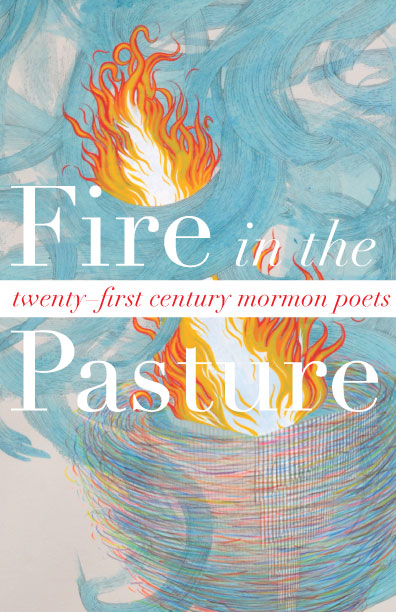
The ambiguity, doubleness, abundance [of the anthology and the image of fire] extends to the cover painting, which has what looks like an upside down drawing of the Community of Christ temple in the midst of the fire, but when you turn the painting upside down the line drawing looks like the Nauvoo temple, seen at a slight tilt, as someone coming up a hill might see building on the crest.
In “The Shape of the Fire” Theodore Roethke celebrated “The shapes a bright container can contain,” and this book is a particularly bright container, the kind where you may throw one poem into the fire and when you look to see the shape in the fire you find two or three there.
–Harlow Clark,
for the Association for Mormon Letters
* * *
With Fire in the Pasture [. . .] editor Tyler Chadwick casts his net wide to offer readers some of the best LDS poetry produced since the millennium’s turn. With his preface, along with Susan Howe’s contextualizing foreword, readers are well-equipped to form their own opinions about the state of LDS poetry. Most readers will undoubtedly feel at ease browsing its pages, discovering old friends, and perhaps forming some new acquaintances. [. . .]
This anthology is well worth its moderate price and it is easily accessible to anyone with an Internet connection. If readers want truly thoughtful and articulate expressions of and insights into the many voices with which modern Mormonism speaks one would be hard-pressed to locate a more convenient source.
–Brent Corcoran,
for Dialogue: A Journal of Mormon Thought
* * *
Okay, so this is a little bit misleading because I haven’t read the entire tome of poems yet. I’m a cherry picker when it comes to poetry–rifling through the pages reading what catches my eye or jives with my current mood. (Reading a poetry book straight through, cover to cover just seems wrong. Like nails-on-a-chalkboard wrong.) But I own this one and I love it! Chadwick did an amazing job editing this work. There is such a breadth of work and so many poets to explore, this is one I’ll keep returning to. This book is well worth the money–I promise it’s bigger than you think it will be!
–Laura Craner,
Blogger, A Motley Vision: Mormon Literature and Culture
* * *
I got this book for Christmas last year and eagerly dove into it. I’ve read a few poems a day since then, savoring each one. Normally, I am quite intimidated by large anthologies of poetry, preferring instead the slim individual collections I can read in under a week. But I knew this anthology would be worth the sustained effort, and it was. SO many excellent poets, so many different ideas and images. Reading this book was a thoroughly enjoyable experience. I think I have dogeared more pages than I haven’t. I highly recommend it to anyone interested in contemporary poetry.
–Dayna Patterson,
Poet and Editor of Psaltery & Lyre
* * *
Although the readership of poetry anthologies is not large, it is encouraging that Fire in the Pasture collects and preserves many of Mormonism’s most potent poetic voices from the early twenty-first century, making them available for generations to come. This volume would also be a quality addition to any literature class, Mormon or otherwise, especially at LDS schools. Although not all the poems in the anthology have overtly Mormon elements, many address ideas and issues at the core of our theology and culture. For those who erroneously believe that LDS poetry is primarily comprised of sentimental rhymed verses or charming couplets, this anthology is proof that the complexity and beauty of Mormon life can, and should, be rendered in powerful, sophisticated poetic expression.
–Angela Hallstrom,
Novelist and Editor
Interviews
What is poetry’s place in contemporary Mormonism?
[Clinton F.] Larson, [the father of modern Mormon poetry,] suggests in [an interview with Ed] Geary that “[p]art of the spiritual record that must be kept [by the Latter-day Saints] is the poetry of the people.” He then warns that without a “body of significant and enduring poetry” to connect the Saints sensually and aesthetically to their religious experiences, Mormonism’s cultural heritage would be in jeopardy. He actually says it would “not, in fact, exist.” Poetry, then, as Pulitzer Prize winning poet Robert Hass observes, is “a sign of cultural health.” It’s an indication, Hass continues, that “a lot of people [in the culture are] literate and alive,” simply because “[y]ou have to have some kind of interior life to make [and to enjoy] a work of art and in a world as busy and heedless as this one we need all the consciousness we can muster” in order not to wither on the vine, as it were. So poetry comes of introspection and carries with it an abiding awareness that the inner life matters. And this strikes me as being especially relevant to Mormons in terms of the LDS quest to marry our inner- and outer-lives, to expand our personal and cultural consciences and consciousness toward the establishment of Zion.
Read the full interview »
Read the uncut version of the interview »
–from Tyler Chadwick’s interview with Scott Hales
from Modern Mormon Men & The Low-Tech World: Exploring Mormon Literature